




















Brads, Pins or Staples: Getting Workshop Assembly Right
In workshop assembly, the fixing should suit the job, not just the tool on the bench.
Brads, pins and staples can all speed up production, improve consistency and reduce time spent clamping or holding parts by hand. But each one performs differently. Choose the wrong fixing, and you can end up with visible marks, weak hold, split material, damaged panels or unnecessary rework.
For joinery workshops, furniture makers, shopfitters, upholstery teams, packaging users and general production environments, the right fixing makes a real difference. It affects how clean the finished work looks, how well the material holds, and how smoothly the tool performs across a busy day.
At The MTK Group, we help trade users match fasteners to the tool, material and application, so the fixing works properly from the first shot.
Start with What the Fixing Needs to Do
It is easy to reach for whatever fastener is already loaded in the tool.
But the better question is: what does the fixing need to achieve?
Sometimes the fixing is there to hold a part while the adhesive cures. Sometimes it needs to secure a cabinet back, fix a moulding, hold a furniture frame together or pull a panel tight to a timber rail. In other jobs, the priority is appearance, and the fixing mark needs to be as discreet as possible.
That is why brads, pins and staples should not be treated as interchangeable.
A pin may be ideal for a delicate trim where the glue is doing most of the work. A brad may be better where you need a cleaner finish with more hold. A staple may be the right choice where the fixing needs to grip over a wider area.
The job should lead the fixing choice.
When to Use Brads
Brad nails are a good all-round choice for many workshop assembly tasks.
They offer more holding power than a fine pin, while still leaving a relatively small fixing point. This makes them useful for trim, mouldings, beading, light joinery, cabinet work, furniture components and panel fixing.
Brads are often used where the material needs to be held neatly in place without using a larger nail or screw. In many workshop jobs, they also act as a clamp while adhesive sets.
Typical uses include trim and mouldings, cabinet work, light timber assembly, furniture frames, beading, decorative joinery and panel fixing.
They are a practical choice when you need a balance between appearance and hold.
When Brads May Not Be Enough
Brads are versatile, but they are not designed for every load or material.
If the component is heavy, likely to move, or under regular stress, a brad may not give enough strength on its own. The same applies if the wrong length or gauge is used.
Brads can also split thin timber if they are fired too close to the edge, or if the air pressure is too high. In brittle material, MDF edges or narrow trim, the setup needs to be right.
If brads are sitting proud, bending, blowing through or leaving too much marking, check the fastener length, air pressure, tool condition and material before assuming the fixing itself is the only issue.
When to Use Pins
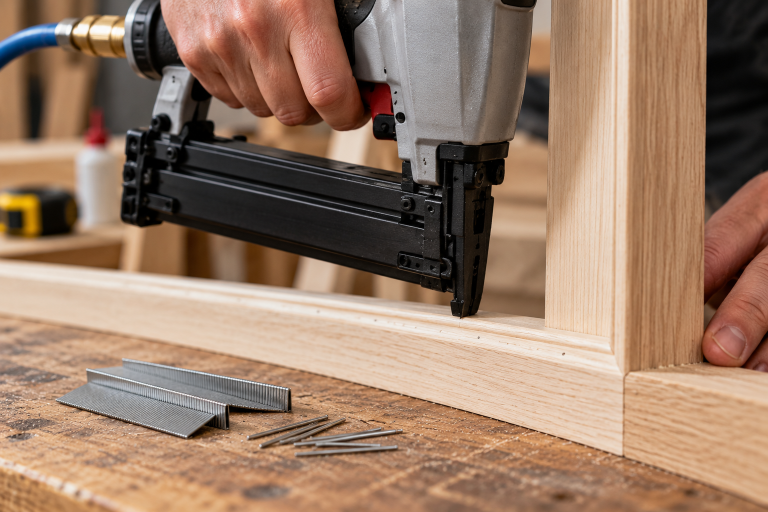
Pins are used when the finish matters most.
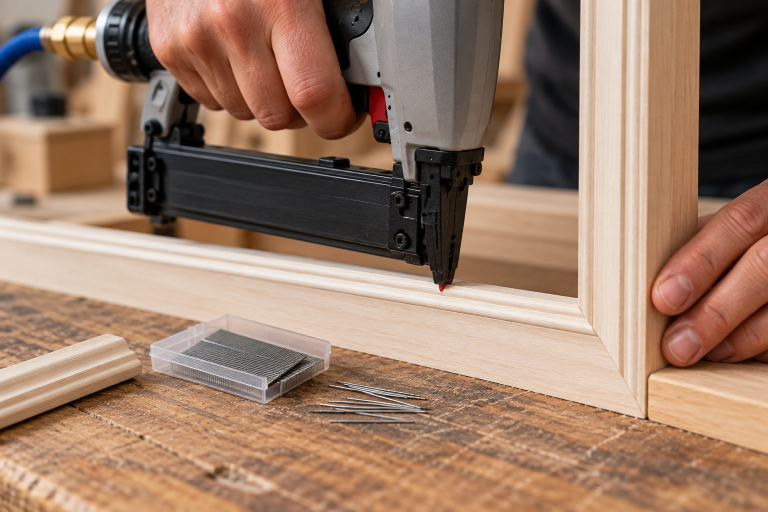
Headless or slight-head pins leave a very small fixing mark, which makes them useful for fine mouldings, glazing beads, decorative trim and small timber sections. They are especially helpful where a larger fixing would be too visible.
In many cases, pins are used to hold a part in position while adhesive does the main work. That makes them useful for delicate finishing jobs where appearance is more important than maximum mechanical strength.
Typical uses include fine trim, glazing beads, decorative mouldings, small timber sections and discreet holding while adhesive cures.
Pins are neat, quick and subtle but they are not a substitute for a stronger fixing where strength is required.
Where Pins Can Let You Down
A pin has limited holding power.
Because it is very fine, and often headless, it does not grip the same way a brad or staple does. That is fine when the adhesive is doing the main work, but it can be a problem if the pin is expected to hold the assembly by itself.
Pins can also deflect in dense timber or follow the grain if the angle, length or material is not right. In narrow sections, they can come through the side and spoil the finish.
Use pins where discretion matters. Do not rely on them where the fixing needs to carry the joint.
When to Use Staples
Staples are chosen when grip and holding area matter.
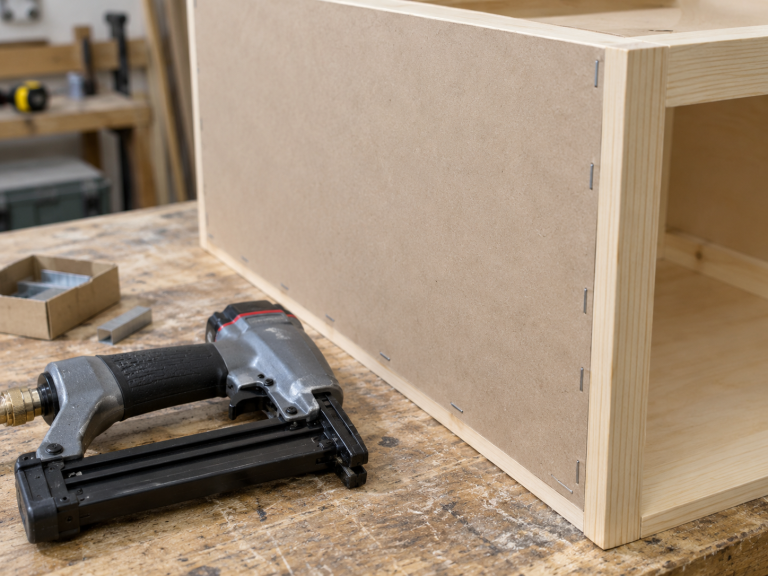
Because a staple has two legs and a crown, it holds across a wider area than a single brad or pin. That makes it useful for cabinet backs, panel fixing, upholstery frames, lining work, insulation, packaging, crates, pallet work and general timber assembly.
Staples can be especially effective when securing sheet material to a frame or pulling a panel tight to a rail. In production work, they can also be fast and consistent when matched to the correct stapler and material.
Typical uses include panel backs, furniture frames, upholstery frames, packaging, crates, lining, insulation and light timber frames.
Staples are not always the neatest fixing visually, but they can be one of the most practical options when strength and surface grip matter.
When Staples Are the Wrong Choice
A staple can be too aggressive for some jobs.
If the wire is too heavy, the crown too wide, the leg length too long or the pressure too high, staples can crush, split or mark the material. This is especially important in visible joinery, softer timber, MDF edges and upholstery work.
Staples also need to match the stapler exactly. Small differences in crown width, wire type, leg length or series can cause jams, misfeeds or poor firing.
If a staple is not seating properly, more air pressure is not always the answer. The fastener may be wrong for the tool, the material may be unsuitable, or the tool may need checking.
Material Makes the Decision Easier
The material should always influence the fixing choice.
Softwood will usually take brads, pins and staples more easily, but it can still split or mark if the fixing is too heavy or too close to the edge.
Hardwood may need more care because lighter pins and brads can bend, deflect or fail to drive properly.
MDF can give a clean finish, but edges are vulnerable to splitting if the fixing is too large or fired too close.
Plywood and sheet materials often need enough leg length or shank grip to hold securely to the frame beneath.
Fabric, foam, leather and vinyl need the right staple wire and pressure to avoid tearing, cutting or overdriving.
The same fastener will not behave the same way in every material, so test firing is always worth doing before running a batch.
Tool Setup Still Matters
Even the right fastener can perform badly if the tool is not set up correctly.
Air pressure, magazine condition, driver blade wear, nose alignment and fastener compatibility all affect the result. Too little pressure can leave brads, pins or staples sitting proud. Too much pressure can overdrive the fixing, damage the surface or increase tool wear.
If a tool starts jamming after a fastener change, the tool may not be the problem. The fastener specification should be one of the first things to check.
Look at the series, gauge, crown width, leg length, collation and tool compatibility before continuing.
Think About Finish and Strength Together
The best fixing choice is usually a balance between finish and hold.
Pins are best when the fixing needs to be discreet and adhesive is doing most of the work.
Brads are useful when you want a cleaner finish with more holding strength than a pin.
Staples are better when you need wider grip, stronger practical hold or secure fixing across panels, frames and sheet materials.
There will always be overlap, but the decision should come back to the job. A neat fixing that does not hold is a problem. A strong fixing that damages the finish is also a problem.
Quick Guide: Brads, Pins or Staples?
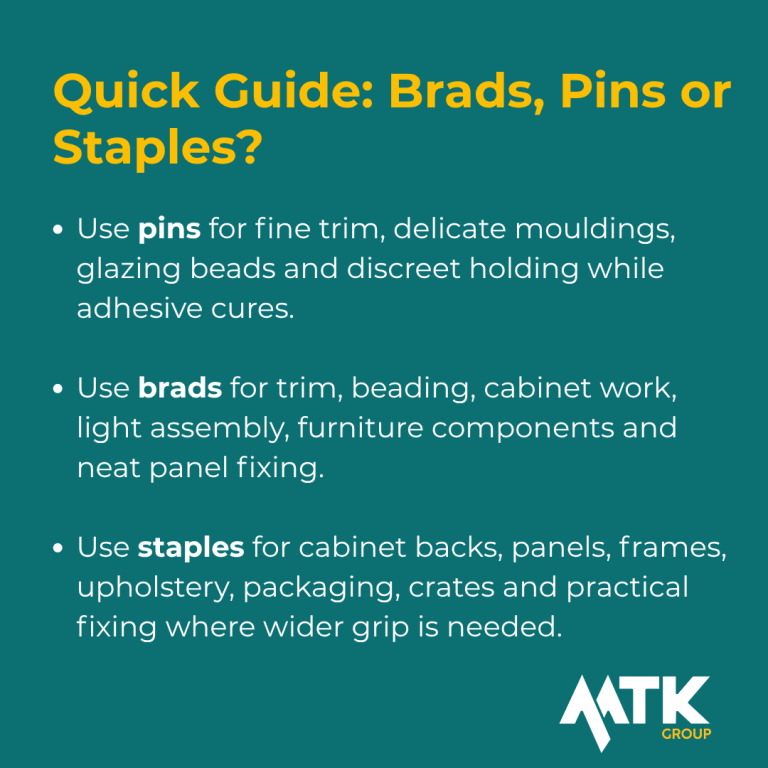
As a simple rule, start with the finish required, then check the level of hold needed. If appearance is the priority, pins or brads may be the better route. If strength and surface grip are the priority, brads or staples are usually more suitable.
Final Thoughts
Brads, pins and staples all have a place in workshop assembly.
The right choice depends on the material, the finish, the level of hold required and the tool being used. Pins give a discreet finish, brads offer a useful balance, and staples provide stronger grip across a wider fixing area.
Choosing correctly helps reduce rework, protect the finished material, avoid tool problems and keep production moving.
At The MTK Group, we supply collated fasteners and pneumatic tools for a wide range of trade applications. Whether you are working with trim, panels, frames, furniture, upholstery, packaging or general workshop assembly, our team can help you find the right fixing for the job.
If you are unsure whether you need brads, pins or staples, get in touch with our team on 0333 8000 345, email [email protected], or DM us on social media @theMTKgroup.